
Competing for Math Education
Competing for Math Education argues that the traditional Algebra-to-Calculus track undersells what math really is. By introducing competition math’s creative, cross-topic problem-solving, it shows how classrooms could shift from rote practice to real insight - for every student.
MATH
Neev Shaw
2/1/20269 min read
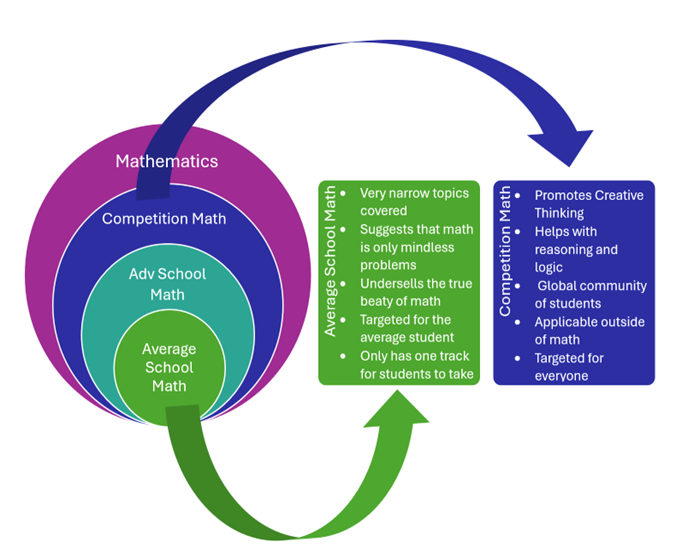
The standard track of mathematics in almost every high school in America follows the same progression: Algebra I, Geometry, Algebra II, Precalculus, then Calculus. Many students might even think that this is all there is to math - just some standard equations with a bit of fancy diagrams and shapes here and there. While this track can serve as a great introduction into mathematics for learners who may not feel as inclined towards the subject, it completely undersells the true nature of math. And for those who are vested in the subject, they might falsely believe that simply plowing through the school curriculum means that they can be advanced mathematicians. Ironically, these students struggle with math problems that many middle schoolers could solve in seconds, unable to identify where to even begin. Why is that?
Competition math is a completely different field of mathematics than the type that is taught in the education system. It takes a unique approach to teaching math by covering a wide variety of topics in a very high-level manner, rather than bulldozing through a specific subset of math. It includes concepts like Number Theory (the study of integers and their relationships), Counting (counting how many ways an event can occur), Probability (the chance of an event happening), alongside the Algebra and Geometry most are familiar with. While it lacks the depth that school math achieves, it thrives in aspects like creativity, problem-solving, perseverance, pattern-spotting, and a little bit of lucky insight. By allowing students to think for themselves instead of mindlessly solving practice problems, competition math can help students see the real beauty of math - that’s not simply limited to what is currently taught in the classroom.
Math competitions like MATHCOUNTS, the American Math Competitions, and even the International Math Olympiad recognize the benefits of this type of math and therefore make their tests based on these topics. There will rarely be a contest that simply tests students’ knowledge of the math taught in schools. These competitions understand that the broader version of math allows for much better questions that encourage students to combine concepts that they’ve been taught and form their own conjectures. While actively participating in these competitions greatly increases a student’s understanding and depth of knowledge, simply teaching the core concepts of contest math in the classroom can provide huge benefits. Suspending what you know and being willing to try out new things are essential to succeed in this field - and these are skills that can help students in many aspects, outside of math.
One of the main reasons that competition math is so helpful when compared to school math is the fact that it gives students a whole new perspective - allowing them to see solutions that couldn’t have seen before. The types of problems found in math competitions are specifically designed to be solved using inventive thinking. Instead of bashing out long and tedious calculations, these problems require students to find a clever way to rephrase the problem or set it up, revealing an elegant pathway to the finish.
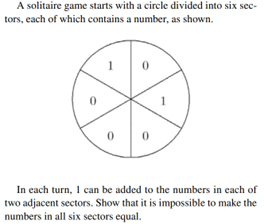
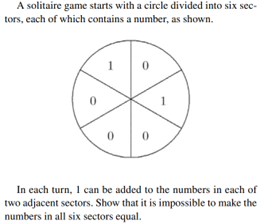
For example, take this easy-to-understand problem.
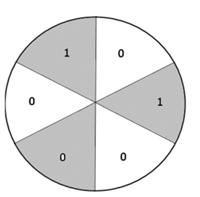
At first glance it seems like it would be extremely difficult to go through all the possible combinations of adding two adjacent sectors. And it would be! To those who have never been exposed to a problem of this sort, it can be easy to simply dismiss this problem as a useless brainteaser that they cannot solve. However a seventh-grader who had been practicing competition math, simply thought about it for a minute then redrew the diagram as the following.
His proof then consisted of three extra sentences. If the numbers in all sectors are equal, then the sum of the numbers in the shaded region and unshaded region must be the same. Adding 1 to two adjacent sectors must increase the sum of the numbers in both the shaded region and unshaded region by 1 each. Since the sums start out unequal, they will continue to be unequal making it impossible for the numbers in all six sectors to be the same (de Losada 13). And this is just one problem! Imagine solving these types of problems all day during school hours; pretty soon, students would be able to come up with the insights by themselves, allowing them to solve difficult problems that cannot be accomplished by routine calculations. By bringing contest math to the classroom, students could spend even more time developing these important skills. The current school math on the other hand spends an unreasonable amount of time emphasizing accuracy and rote memorization through tedious worksheets and never-ending problem sets. While this allows students to learn fundamental concepts through trial and error, as well as gain a deeper understanding of the material, it has little benefits outside of math. Competition math takes a “more engaged approach to learning, helping students develop skills that are valuable both in mathematics and in broader academic contexts” (Sujatha 2). Through creative problem-solving from new lenses, competition math ultimately prevails in terms of benefits to individual students.
Competition math isn't just a solitary process that only benefits individuals - in many cases, it emphasizes collaboration and connection in a much more meaningful way than traditional school math. From math clubs in individual schools to a worldwide community of “mathletes,” competition math offers the chance to work with others and “find friendship, inspiration, and encouragement to a far greater degree than most of these students can find in the typical classroom” (Art of Problem Solving). With school math, students may collaborate to solve worksheets - but it is mainly trying to find out where to apply a specific formula. Instead students in math competitions can find completely different ways to solve problems allowing them to explore concepts in many math fields. Additionally, “these interactions not only enhance their mathematical understanding but also help develop interpersonal skills that are essential in academic and professional settings” (Sujatha 2-3). In a study of math competitions in New Zealand, researchers found that students, who learned competition math in a school environment and participated in team competitions, were able to support others and find their own niche specialty. Additionally, they could build off each other’s ideas and learn from their teammates - in order to learn to get better at different areas of math. The study concluded that “competitions should be acknowledged in school policy as part of the mathematics program” (Bicknell 7). Another great example of connection within contest math is the Art of Problem Solving (AoPS) community. Founded by American Math Olympiad winner Richard Rusczyk, AoPS is the hub for anything and everything competition math related. It has almost one million users, making it one of the biggest global math communities. This means that students almost never feel alone while studying, practicing, or competing in competitions, because they have a worldwide support group at their fingertips. When asked what they think are advantages of students taking part in mathematics competitions, even teachers responded that it would develop “various personal skills and [allow for] more mathematical interactions with other people” (Akveld 9). School math simply cannot compete with the level of interaction, engagement and connection that students get when actively learning competition math.
Students aren’t the only ones who will benefit from the integration of competition math into the school curriculum, however; teachers would also have a lot to gain from it as well. According to a study by Swiss mathematician Meike Akveld, the leader of a popular math competition in Switzerland, teachers in different parts of the world all reported that the involvement of students in competition math would “increase the number of motivated students in a class,” give them materials as a “source of new problems and ideas,” and encourage them to gain a “deeper understanding of the underlying ideas” behind some of the challenging problems (Akveld 7-8). With more engaged students, teachers would be able to engage in fruitful discussions on interesting problems, rather than lecturing on and on about a topic - something that is fun for neither students nor teachers. This type of connection can only happen through a sustained effort to teach competition math in the classroom - instead of leaving it up for students themselves to do it themselves. Competitions also provide mathematical educators to “continue to find a field for fertile collaboration” (de Losada 3). From coming up with intriguing problems to creating solution sets for those problems, contest math provides ample opportunity for teachers to collaborate and help their students gain as much as possible from their classes. School math doesn’t really offer a lot of benefits to teachers outright. Its main strengths are the fact that it has been tried and tested for decades, meaning that there is a lot of material out there for teachers to use. Plus, that is probably how they were taught math themselves many years ago, so it would be much easier for them to teach their students. Still, these don’t really count as benefits as they are conveniences. The integration of competition math into the normal school curriculum would definitely outweigh the hassle of switching gears from a decade-old system.
However, there are some major points that need to be considered in order to successfully incorporate competition math into the curriculum. First, some competitions put more emphasis on speed and accuracy rather than promoting creativity, or outside-the-box thinking. These contests just reinforce that math is simply memorizing facts and bashing out calculations, and “such contests run the risk of encouraging students to overvalue skills that aren’t nearly as valuable as the one asset a contest should help them develop — the ability to think about and solve complex problems” (Art of Problem Solving). Plus, if not executed properly, competition math can still sell the idea that the subject is a collection of problems. It’s important to stress that simply solving questions isn’t the main goal but actually learning techniques to see difficult problems and simplify them to make them more manageable. And while competition math does spend more time on developing the important skills mentioned earlier, there will still be a need for some memorization and practice drills - but far from the scale that school math has students do. Also forcing students to actually compete in competitions is never a good idea, because it can unnecessarily stress them or run the risk of burning out. Especially considering the fact that teachers could extend the kids beyond their ability, discouraging them when they encounter problem after problem that they are unable to solve. Even just learning about competition math and solving those problems without the pressure of time, expectations, or winning can provide enormous benefits to students.
Opportunities to participate in math competitions or learn the core concepts should be extended to all students. It is important that every student feels comfortable and supported when being taught because it is a big shift from the normal curriculum. Even though it might seem that this program would only work for those who are gifted and talented at math, it is simply not the case. Students who may not like math or who feel that they are not good at it would still benefit from learning contest math. Because it takes a broad overview of so many concepts, they will be able to start from scratch every time the class goes over a different subtopic. This allows students to be on the same page as each other throughout the school year, as opposed to being confused about a topic early on in the year and being unable to comprehend everything that follows. If all these points are addressed, then students and teachers will be able to see the growth and reap the benefits that contest math provides.
Competition math is an extremely valuable part of math that more accurately captures the wide range of topics found in the subject. By only spending time on a broad overview of a variety of topics in math, competition math allows time for students to learn how to think critically, invent elegant solutions, see patterns, and collaborate effectively on problems that actually promote solvers to stop and ponder - instead of plugging numbers into a formula. As such, it is extremely important to teach all students about it - alongside the regular school math. It would definitely be unwise to simply get rid of school math altogether, but it cannot stand alone. Instead schools should teach them both side-by-side in order for students to truly get a sense of the subject. To start off, schools can use some of the tried and tested materials that teach competition math, instead of making their own curriculum from scratch. This can help students get a high quality and smooth transition in order to not overwhelm them with a lot of new information. Some of the most popular books and curriculum on competition math are from the Art of Problem Solving, so using them would be a great start. Additionally, classes can try to start off by only doing competition math problems based on Algebra and Geometry, since students would already be comfortable with those subjects. Then as time goes on, teachers could add new material like Number Theory and Counting in order to show students the vast realm of math. With these steps in mind, let’s bring competition math into the curriculum – together.
Join Us
Inspiring learners to innovate through technology and mentorship.
CONNECT with US
stay in touch with us
info@nexusquest.org
NQ nexusquest.org is an IRS certified 501(c)(3) Nonprofit Organization | EIN# 33-3647471
©2025 All rights reserved