
Intelligence in an Algorithmic World
What does intelligence mean in a world shaped by algorithms? This post explores how artificial and human intelligence differ-- and how understanding those differences can help us use AI more thoughtfully alongside human judgment.
ARTIFICIAL INTELLIGENCE
Neil Shaw
2/2/20266 min read
Artificial intelligence is everywhere, from chatbots like ChatGPT and Copilot to the extremely advanced AI algorithms on YouTube and Amazon. However, with AI advancing so quickly, many people are concerned: will AI replace human intelligence? Can AI really think and empathize like humans do? Before answering any of those questions, we first need to define AI and human intelligence.
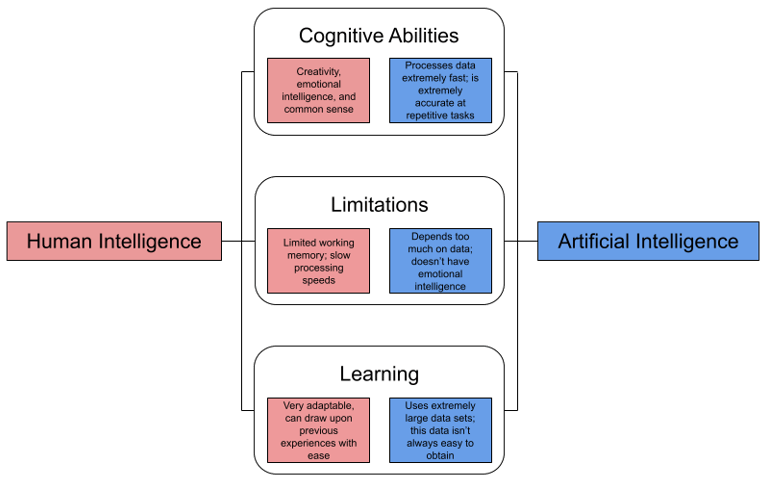
Artificial intelligence is a technology that allows machines and computers to learn, solve problems, and even do some human tasks. Human intelligence, on the other hand, can do much more than just process information. It consists of creativity, empathy, problem-solving, and the ability to learn from experiences using emotions — something that AI can’t really replicate. For instance, self-driving cars powered by AI can make real-time driving decisions based on traffic data, but they are not able to make a decision in ethical dilemmas, such as deciding what to do in an unavoidable accident. A decision like that would require drawing from multiple moral frameworks to understand what decision would lead to the least suffering, which is difficult for humans to accomplish, much less AI. In fact, a study from Oxford University found that “the human brain learns in a way that is fundamentally different from AI systems, particularly when it comes to abstract thinking and reasoning” (Oxford University News). Therefore, while AI can mimic some human behaviors, it does not truly understand or experience emotions the way people do. The ability to make decisions based on empathy is a key component of intelligence, as it is a clear indicator of a deep understanding of context, consequences, and ethics that stretch far beyond data processing.
Nevertheless, even though AI’s empathy skill is underdeveloped, its data processing ability is extremely impressive. AI can handle huge amounts of data incredibly fast, making it very useful for repetitive tasks. For instance, an AI system can analyze thousands of medical scans in minutes, something that would take a human doctor much longer. Researchers from Clemson University and the University of Buffalo have found that “AI systems can [even] recognize patterns in data with a speed and accuracy that far exceed human capabilities” (Chowdhury). However, while AI excels at processing information, it struggles with tasks that require creativity or common sense. Humans, on the other hand, are naturally creative and can think outside the box. Unlike AI, people can write poetry, create artwork, and come up with solutions to problems.
Some may argue that artificial intelligence can do these tasks. However, they are not taking into consideration the creativity that is involved. AI is trained on massive databases of previously created pieces of art. So when it ‘creates’ another piece of art based on prompts from humans, it is not actually creative or novel — it’s just stealing from already existing works. Not to mention, AI ‘art’ can be clearly discerned from human art in many cases due to inconsistencies such as depicting deformed hands, lack of perspective, and uniform texture, which further shows how unoriginal it is.
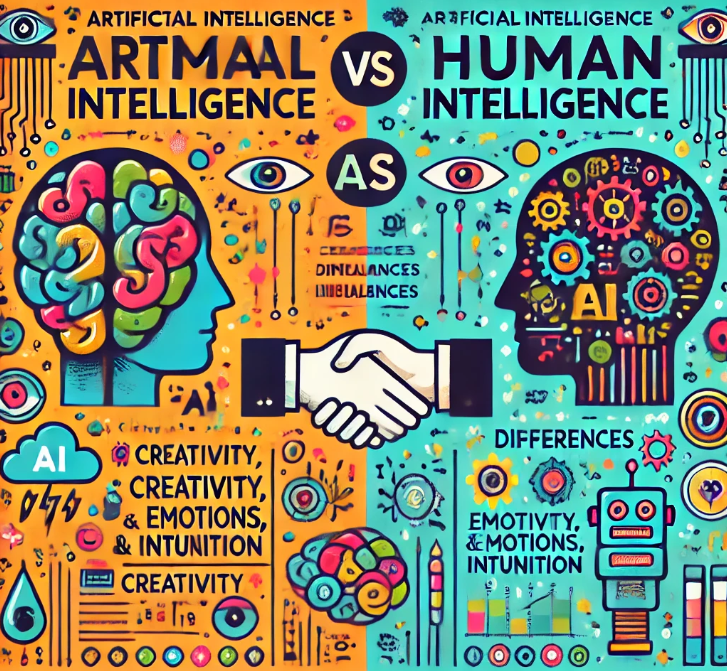
This image shows an AI-generated poster comparing and contrasting Human intelligence and Artificial Intelligence.
Just like with creativity, AI is incapable of having empathy. While AI-powered chatbots (text-based artificial intelligence) can generate responses that seem empathetic, they do not actually feel or understand emotions and falter at tasks that require basic reasoning. This is why AI may struggle in fields that require deep emotional connections, such as therapy or caregiving. Even in fields like writing, AI-generated content often lacks the depth and originality that come from human experience and emotion. This phenomenon occurs because AI models function based on probabilities, selecting responses that are statistically likely to be correct rather than actually understanding the concepts behind them. While AI may perform well in structured environments, it struggles in unfamiliar situations. It’s no secret that AI is fairly easy to trick or gaslight; it simply isn’t able to reason independently, which leads to this gullibility present in almost all AI systems. Humans, on the other hand, are able to reason through complex problems, make inferences, and adjust their thinking based on context. This ability is what allows people to think critically, develop philosophical ideas, and make scientific discoveries—areas in which AI fails.
Hence, although AI is impressive, it still has some major limitations; one of the biggest weaknesses of AI is that it learns by analyzing massive amounts of data and finding patterns. This might not seem like a limitation, but AI needs structured data to learn, and gathering this data can be extremely difficult. Even though it is possible to train AI on a small data set, this AI’s output will be highly inaccurate. Depending on the context, this high level of inaccuracy could lead to drastic consequences. Additionally, even though AI has shown that it can be incredibly powerful, it “is limited by the quality… of the data it receives” (Trends in Cognitive Sciences). Almost all the data AI is fed stems from some form of human intelligence, so if there are any mistakes or biases in the data (as is characteristic of human intelligence), the AI will show those biases in its output. Even with all its technological prowess, “AI lacks the ability to think beyond its programming and cannot make decisions based on intuition or past experiences like humans can” (Maryville University). As researchers at MIT point out, “AI decision-making can reflect biases present in training data, making ethical decision-making challenging without human oversight” (MIT Technology Review). For example, the use of AI in law enforcement and healthcare testing has been criticized for biases that stem from the data it is trained on. For instance, one study found that “a health care risk-prediction algorithm, a major example of tools used on more than 200 million people in the U.S., demonstrated racial bias” (Vartan). Without human oversight, AI can make unfair decisions based on historical data instead of ethical reasoning. Humans, on the other hand, have the ability to reflect on their actions, consider different perspectives, and make ethical choices based on a combination of logic, emotions, and social norms.
Some people are concerned that AI will replace many jobs. However, AI lacks emotional intelligence, which is extremely important in fields like psychology, education, and leadership. While AI can analyze customer reviews and predict trends, it can’t empathize with a frustrated customer in the same way that a human can. Similarly, AI can’t understand cultural and ethical issues. Even though AI is trained on enormous amounts of data, it still can’t fully grasp cultural or ethical dilemmas that are present in different societies. AI is “showing... a lack of diversity and cultural sensitivity” (Murdoch University) something that is simply inexcusable. Some AI models are even “being called out for an inability to generate images of interracial couples, which is symptomatic of a much bigger problem” (Murdoch University). These issues plague many artificial intelligence systems, and they are a huge limiting factor in the growth of AI.
At the same time, though, humans have their own limitations. Unlike AI, which can process millions of calculations in seconds, the human brain is much slower when it comes to raw data processing. Humans also have limited working memory, which means they can only hold a small amount of information at a time. However, humans make up for these limitations with their ability to adapt, think critically, and learn from past experiences. According to neuroscientist John Medina, “The human brain is remarkably flexible and can rewire itself based on new experiences and challenges, something AI has yet to achieve” (Medina). While AI is fast, it is not flexible. If an AI system encounters a situation it has not been trained for, it will likely fail. Humans, however, can quickly adjust to new environments and challenges, which is one of the main reasons why humans have been able to survive for thousands of years. Without this level of adaptability, humans would not be thriving as much as they are now.
With humans’ adaptability comes the ability to apply knowledge from one situation to another. Research from Harvard University states, “Humans possess the ability to generalize knowledge across different domains, whereas AI typically requires extensive retraining for new tasks” (Harvard AI Research Center). For example, a child who learns how to tie their shoes can use that same skill to tie a bow on a gift. AI, however, would need to be specifically trained for each of these tasks separately. Another important difference is that humans engage in lifelong learning, constantly refining their understanding of the world through personal experiences, cultural interactions, and emotional growth. AI, on the other hand, only updates when new data is introduced, meaning it can easily become outdated and worthless.
As AI continues to evolve, it might become even more advanced, but, most likely, it will never reach the complexity of human intelligence. Instead of replacing humans, AI will likely serve as a tool that enhances human capabilities rather than replacing it. As AI continues to be developed and refined, it is important to remember that “intelligence is not just about processing information—it is about understanding, feeling, and creating, all of which make human intelligence truly unique” (Smith). While AI may never reach the omnipotent level that science fiction suggests, AI will undoubtedly continue to improve and help humanity, especially with continued work toward erasing biases, increasing precision, and combining human and AI strengths for effective collaborations.
Join Us
Inspiring learners to innovate through technology and mentorship.
CONNECT with US
stay in touch with us
info@nexusquest.org
NQ nexusquest.org is an IRS certified 501(c)(3) Nonprofit Organization | EIN# 33-3647471
©2025 All rights reserved